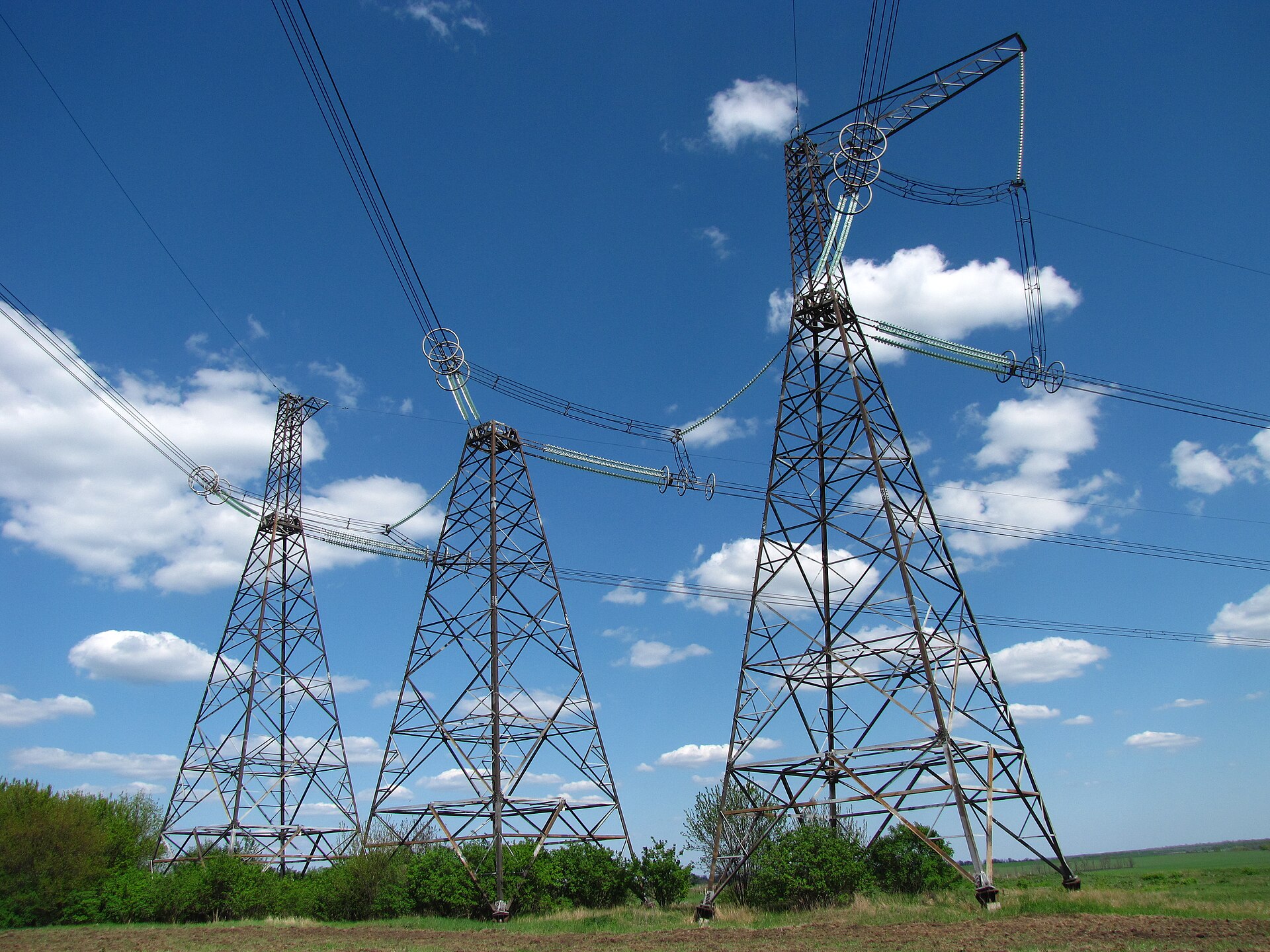
Photo: Novoklimov via Wikimedia Commons, CC0 1.0 Universal Public Domain Dedication.
Quick Answer: ERCOT’s Reliability Plan for the Permian Basin Region projects regional electric demand of 23,659 megawatts in 2030 and 26,400 megawatts in 2038, roughly two and a half times the 2021 study’s figure. Meeting it requires about 13.8 billion dollars of transmission at 765 kilovolts, and Texas regulators approved the first 765-kilovolt lines in the region on April 24, 2025. The build-out is now in the courts and the routing fights, not the planning stage.
How much electricity will the Permian Basin actually need?
The governing numbers come from ERCOT’s Reliability Plan for the Permian Basin Region, filed with the Public Utility Commission of Texas on July 25, 2024 and required by House Bill 5066 from the 88th Legislature. The plan studied two load cases. In the 2030 case, total Permian regional load reaches 23,659 megawatts, split between 11,964 megawatts of oil and gas load and 11,695 megawatts of additional non-oil-and-gas load. In the 2038 case, total load reaches 26,400 megawatts, with oil and gas rising to 14,705 megawatts and the non-oil-and-gas component held flat at 11,695 megawatts.
The trajectory is what makes those figures remarkable. ERCOT’s 2019 Delaware Basin study put oil and gas load at 9,771 megawatts. The 2021 Permian Basin study’s 2030 case came in at 10,527 megawatts. The 2023 regional transmission plan study, using a 2029 case, reached 16,577 megawatts in total, of which 12,341 megawatts was oil and gas and 4,236 megawatts was not. In other words, the non-oil-and-gas component of Permian load rose from roughly 4.2 gigawatts in the 2023 study to roughly 11.7 gigawatts in the 2024 plan. That single line item is the largest change in West Texas electricity planning in a decade, and the plan does not break it down further into data centers, hydrogen or other categories.
| Study | Case year | Oil and gas | Non-oil-and-gas | Total |
|---|---|---|---|---|
| 2019 Delaware Basin study | – | 9,771 | Not stated | 9,771 |
| 2021 Permian Basin study | 2030 | Not stated | Not stated | 10,527 |
| 2023 regional transmission plan | 2029 | 12,341 | 4,236 | 16,577 |
| 2024 Permian Basin Reliability Plan | 2030 | 11,964 | 11,695 | 23,659 |
| 2024 Permian Basin Reliability Plan | 2038 | 14,705 | 11,695 | 26,400 |
What did ERCOT propose, and what does it cost?
The plan’s structure is straightforward: a package of local upgrades inside the basin, plus multiple import paths bringing power in from elsewhere in the ERCOT footprint. The local upgrade package costs 4.02 billion dollars and is identical across every voltage option studied, because the Permian needs those upgrades regardless of how power arrives. The variable is the import paths.
For the 2030 case at 345 kilovolts, import paths cost 3.99 billion dollars and incremental local work 1.03 billion dollars, for a total of 9.04 billion dollars. For the 2038 case the arithmetic diverges by voltage. At 345 kilovolts, import paths cost 7.69 billion dollars and incremental local work 1.23 billion dollars, totaling 12.95 billion dollars. At 500 kilovolts the total is 15.32 billion dollars. At 765 kilovolts the total is 13.77 billion dollars, which is the figure usually rounded to 13.8 billion dollars in public discussion.
The engineering case for the higher voltage is in the transfer capability and the land. Incremental transfer capability in the 2038 case is 1,340 megawatts at 345 kilovolts, 1,712 megawatts at 500 kilovolts and 2,105 megawatts at 765 kilovolts. The number of import paths required falls from five to four to three. New right-of-way falls from 1,676 miles to 1,370 miles to 1,255 miles. Losses at peak fall from 3.0 percent to 2.8 percent to 2.7 percent. Average line cost per mile moves the other way, from 4.04 million dollars at 345 kilovolts to 6.10 million dollars at 765 kilovolts. ERCOT had already endorsed roughly 5.7 billion dollars of Permian transmission since 2014 before any of this.
| Measure | 345 kV | 500 kV | 765 kV |
|---|---|---|---|
| Total plan cost | 12.95 billion dollars | 15.32 billion dollars | 13.77 billion dollars |
| Incremental transfer capability | 1,340 MW | 1,712 MW | 2,105 MW |
| Import paths required | 5 | 4 | 3 |
| New right-of-way | 1,676 miles | 1,370 miles | 1,255 miles |
| Average cost per mile | 4.04 million dollars | 6.86 million dollars | 6.10 million dollars |
| Losses at peak | 3.0 percent | 2.8 percent | 2.7 percent |
What have Texas regulators actually approved?
The approvals came in stages, and the public record is not perfectly consistent on dates. The Public Utility Commission of Texas approved the Permian Basin Reliability Plan in the fall of 2024; ERCOT’s own later summary dates that approval to October 2024 and notes it was made irrespective of the voltage level, while contemporaneous trade coverage reported the vote on September 26, 2024. At that point commissioners directed transmission service providers to prepare applications for eight import paths, five at 345 kilovolts and three at 765 kilovolts, with the voltage question to be settled in 2025.
It was settled on April 24, 2025, when the commission approved the region’s first 765-kilovolt transmission lines for the Permian. ERCOT’s board then voted on December 9, 2025 to endorse two 765-kilovolt projects: a joint AEP Texas, CPS Energy, Oncor and CenterPoint Energy Texas eastern backbone project, and an Oncor and AEP Service Corporation line running from Drill Hole to Sand Lake to Solstice. ERCOT’s published conclusion is that the 765-kilovolt statewide plan provides greater long-term benefits.
The statewide numbers put the Permian package in context. ERCOT’s comparison of the statewide transmission expansion plan priced initial construction at 32.99 billion dollars for the 765-kilovolt version against 30.75 billion dollars for the 345-kilovolt version, a gap of 2.24 billion dollars that narrows to about 1.35 billion dollars once outage minimization and timely completion costs are added. The higher-voltage plan is credited with about 230 million dollars more in annual consumer energy savings, adds roughly 400 more miles of new right-of-way, and avoids about 1,400 miles of upgrades. Both versions require roughly 5 billion dollars a year of transmission investment over six years, against an average above 3 billion dollars a year endorsed in the preceding three years.
How did this plan come about?
The legal origin is House Bill 5066, authored by state Representative Charlie Geren and passed in 2023 with near-unanimous support in both chambers. It required the commission to direct ERCOT to produce a Permian reliability plan. The commission issued that order on December 14, 2023, with a filing deadline in July 2024. ERCOT began work with transmission service providers and its Regional Planning Group in December 2023, held a stakeholder workshop on June 28, 2024, and filed the plan on July 25, 2024. Commissioner Lori Cobos led its development at the commission.
The economic justification commissioners leaned on was congestion. Commissioner Jimmy Glotfelty estimated West Texas congestion costs at somewhere between 100 million and 300 million dollars a year and argued that avoiding them would pay for the lines. That is a commissioner’s estimate rather than an independently audited figure, but it frames the cost-benefit debate: the question is not whether transmission is expensive, it is whether congestion and curtailment are more expensive. ERCOT’s wider planning context reinforces the direction of travel, with its transmission-planning load forecast exceeding 150 gigawatts statewide for 2030 and large-load drivers identified as data centers, hydrogen and hydrogen-related manufacturing, crypto mining, general electrification and further electrification of oil and gas processes.
Why is the build-out still contested?
On August 28, 2026, the commission voted unanimously to approve amendments to two certificates of convenience and necessity filed by Oncor, covering more than 400 miles of 765-kilovolt line running southwest from Bosque County and spanning at least 30 counties. Hundreds of landowner protests were filed. A separate line, Howard Solstice, which would run through South Texas, was tabled for further deliberation. The approval was described as the last administrative hurdle absent a successful legal challenge, and litigation brought by American Liberty Stewards against Oncor, AEP Texas and CPS Energy remains outstanding, with Texas Attorney General Ken Paxton filing an amicus brief supporting the challengers.
The cost allocation argument is the one Permian operators should watch closest. State Senator Kevin Sparks has warned that tens of billions of dollars in construction costs would be socialized into residential bills, a characterization the reporting does not independently confirm. ERCOT’s own framing is more technical: transmission investment costs are typically recovered over a 30- to 40-year period by transmission service providers. Routing, meanwhile, is decided by the commission through the certificate process, not by ERCOT.
Industry pressure has run in the opposite direction. The Texas Oil and Gas Association and the Permian Basin Petroleum Association have pushed against delay, and oil and gas representatives have warned of rolling outages without the new capacity. A concrete illustration offered during the proceedings: Diamondback Energy generates 80 megawatts of its own power and takes 330 megawatts from the grid, and business interconnection waits in the region have been described as running beyond two years.
What does this mean for Permian Basin business?
Interconnection timing has become a production constraint. When a basin’s marginal barrel depends on electric compression, electric frac spreads, electric water handling and electric gas processing, a two-year interconnection queue functions as a drilling permit. The 4.02 billion dollars of local upgrades inside the basin is the portion of the plan that most directly shortens those queues, and it is fixed across every voltage scenario, which means it should proceed on its own schedule regardless of how the 765-kilovolt litigation resolves.
For non-energy businesses in Midland, Odessa and the surrounding counties, the relevant read is that the region is being wired for a load profile roughly two and a half times its 2021 planning assumption. That is the kind of infrastructure commitment that changes site selection math for manufacturing, cold storage, water treatment and large commercial development over a decade. It also means that rate design decisions made in Austin between now and the end of the 2027 legislative session will determine how much of a 13.8 billion dollar regional program lands on local commercial electric bills, which is a line item every Permian employer can model today even without a final answer.
Brian’s Take
The number in this story that would have stopped me cold as an analyst is not 13.8 billion dollars. It is the non-oil-and-gas load line: 4,236 megawatts in the 2023 study, 11,695 megawatts in the 2024 plan. That is a 7.5 gigawatt revision in roughly a year, in a plan that does not disclose what the new load actually is. Everything downstream, the voltage choice, the number of import paths, the right-of-way miles, the cost allocation fight, rests on a forecast component the public document leaves unexplained.
That does not make the build wrong. The transfer capability math at 765 kilovolts is better on almost every axis: 2,105 megawatts versus 1,340, three import paths versus five, 421 fewer miles of new right-of-way, lower losses, and a total cost only about 820 million dollars above the 345-kilovolt option in the 2038 case. If you are going to spend 13 billion dollars either way, buying the higher-capability version for a six percent premium is a defensible trade.
What Permian operators should price into their own plans is the 4.02 billion dollars of local upgrades. That figure is constant across every scenario studied, which means it is the least contingent part of the program and the part most directly tied to shortening a two-year interconnection queue. The litigation over the long 765-kilovolt lines will take the headlines. The local work is what shows up in a well pad’s power schedule.
Frequently asked questions
How much power is the Permian Basin forecast to use?
ERCOT’s Reliability Plan for the Permian Basin Region projects 23,659 megawatts of regional load in its 2030 case and 26,400 megawatts in its 2038 case.
What does the Permian transmission plan cost?
At 765 kilovolts the 2038 package totals 13.77 billion dollars, including 4.02 billion dollars of local upgrades. The 345-kilovolt version totals 12.95 billion dollars and the 500-kilovolt version 15.32 billion dollars.
When did Texas approve 765-kilovolt lines?
The Public Utility Commission of Texas approved the region’s first 765-kilovolt transmission lines on April 24, 2025, after approving the underlying reliability plan in the fall of 2024 without specifying voltage.
Who builds and pays for the lines?
Transmission service providers build, own and operate the lines, and the commission determines routing through the certificate of convenience and necessity process. ERCOT states that transmission investment costs are typically recovered over a 30- to 40-year period by those providers.
What is still unresolved?
Litigation by American Liberty Stewards against Oncor, AEP Texas and CPS Energy is outstanding, and the Howard Solstice line through South Texas was tabled for further deliberation in August 2026.
Sources and Further Reading
- Reliability Plan for the Permian Basin Region – Electric Reliability Council of Texas
- ERCOT Transmission Planning: 345-kV and 765-kV Statewide Transmission Expansion Plan trending topic – Electric Reliability Council of Texas
- Texas OKs Permian Basin reliability plan, option for state’s first 765-kV transmission lines – Utility Dive
- Texas regulators approve two massive West Texas transmission lines amid outcry from landowners – The Texas Tribune