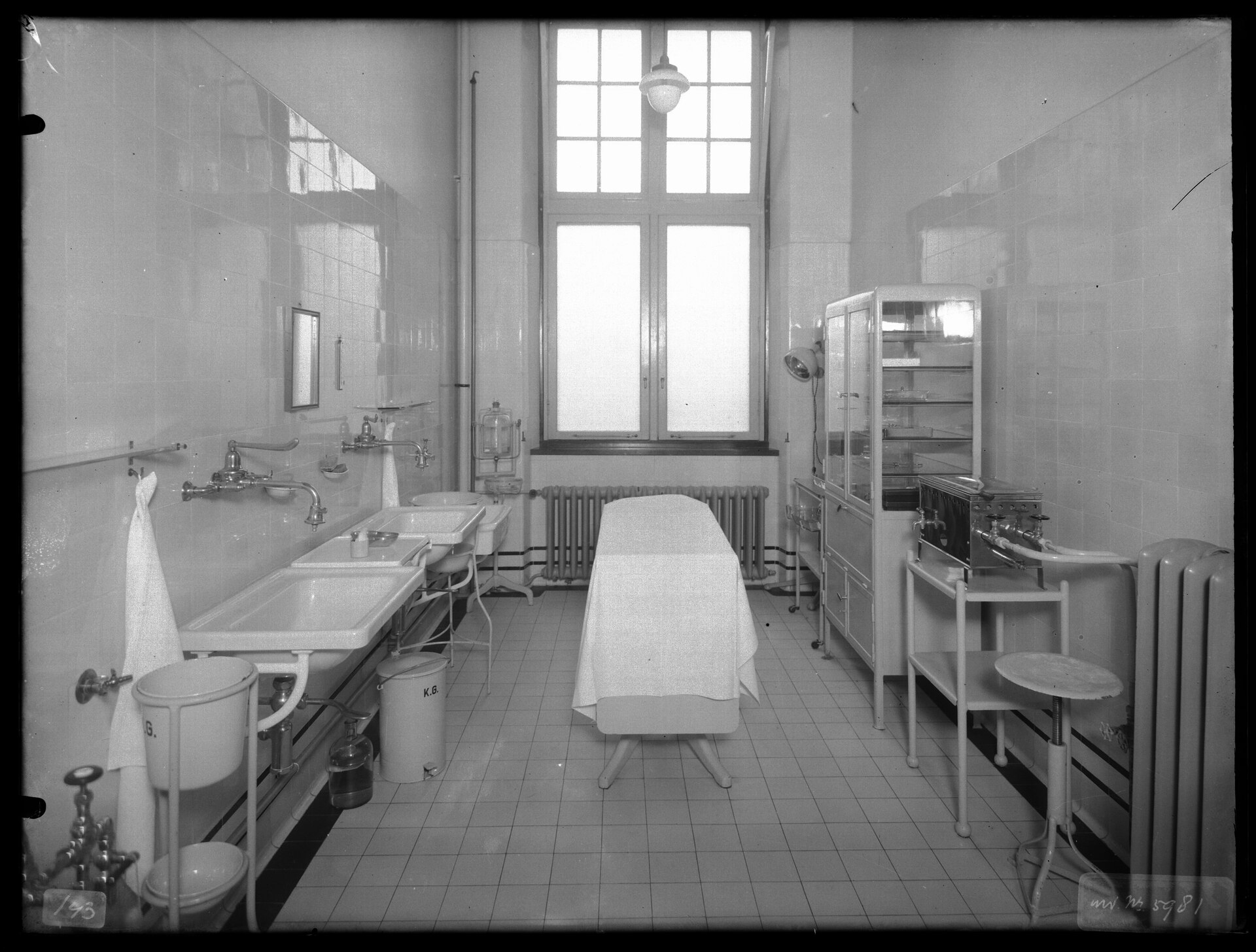
Photo via Wikimedia Commons, public domain.
Quick Answer
Midland employs healthcare practitioners at 3.1 percent of its workforce against a national share of 6.3 percent, and healthcare support workers at 2.3 percent against 5.1 percent. That makes the Permian Basin’s largest metro the most under-weighted major Texas market for health care employment by a wide margin. The gap is closing: Midland’s education and health services payroll grew 8.8 percent over the year to 9,900 jobs in August 2026, the metro’s second-fastest sector.
How under-served is the Permian in health care employment?
The Bureau of Labor Statistics occupational survey for May 2025, released in August 2026, measures the share of each metro’s workforce in every occupational group and compares it with the national share. For health care, the Midland results are stark.
Healthcare practitioners and technical occupations, the group covering physicians, nurses, pharmacists, therapists and technologists, account for 3.1 percent of Midland employment against a national 6.3 percent. That is a ratio of roughly 0.49, meaning Midland employs these workers at about half the national concentration. Healthcare support occupations, which cover nursing assistants, medical assistants, aides and phlebotomists, account for 2.3 percent against a national 5.1 percent, a ratio of about 0.45.
No other Texas metro in the same release series comes close to that level of under-representation.
| Metro | Healthcare practitioners, share | Practitioner mean hourly | Healthcare support, share | Support mean hourly |
|---|---|---|---|---|
| Midland | 3.1% | $48.84 | 2.3% | $16.98 |
| El Paso | 6.0% | $43.48 | 6.4% | $14.23 |
| Amarillo | 7.1% | $47.57 | 3.8% | $17.01 |
| Lubbock | 7.7% | $43.90 | 4.6% | $15.71 |
| Wichita Falls | 7.6% | $42.32 | 6.1% | $16.91 |
| McAllen-Edinburg-Mission | 6.2% | $42.37 | 18.2% | $12.68 |
| Brownsville-Harlingen | 5.8% | $42.91 | 16.6% | $12.79 |
| United States | 6.3% | $52.26 | 5.1% | $19.62 |
Source: U.S. Bureau of Labor Statistics, Occupational Employment and Wage Statistics, May 2025. Shares are the percentage of each metro total employment in the group; mean hourly wages cover all workers in the group.
Read across that table and Midland is the outlier twice over. It has the lowest practitioner share of any metro listed, at less than half the Lubbock or Wichita Falls figure, and the lowest support share, at an eighth of the McAllen level.
Is this a pay problem?
Not in the way one might assume. Midland pays healthcare practitioners $48.84 an hour, the highest figure among the Texas metros in the table and 94 percent of the national mean of $52.26. Amarillo is next at $47.57. El Paso pays $43.48, Lubbock $43.90 and McAllen $42.37.
Healthcare support is a different story. Midland pays $16.98, slightly ahead of Amarillo’s $17.01 in practical terms and well ahead of the Rio Grande Valley’s $12.68 and $12.79, but still 13 percent below the national mean of $19.62.
So Midland pays its licensed clinicians close to national rates and still employs them at half the national concentration. The constraint is not the wage offer.
What is the constraint, then?
The occupational data point to competition for the same workforce. Midland’s mean hourly wage across all occupations was $34.28 in May 2025, above the national mean of $33.54 and the highest of any Texas metro in this release series. El Paso came in at $24.94, McAllen at $22.53, Lubbock at $25.89 and Amarillo at $27.12.
In a metro where the overall wage level already exceeds the national average, a health care employer competes for staff against an oilfield economy paying first-line production and extraction supervisors $87,490 a year and management occupations $75.07 an hour. Healthcare support work at $16.98 an hour, or roughly $35,300 a year, sits far down that ladder.
The structure of Midland employment makes the point. Construction and extraction occupations account for 14.8 percent of local employment against a national 4.1 percent, and installation, maintenance and repair 9.0 percent against 3.9 percent. Together those two groups account for 23.8 percent of Midland’s workforce, against 8.0 percent nationally. That is 15.8 percentage points of the workforce absorbed by occupations that barely register in most metros, and it has to come out of other categories.
Is the gap closing?
The monthly payroll data say yes, and quickly. Midland’s education and health services employment, the industry category that captures most health care jobs alongside private education, recorded year-over-year growth of 1.0 percent in March 2026, then readings of minus 2.9 percent in April and May, before swinging to plus 16.5 percent in June, plus 19.5 percent in July and plus 8.8 percent in August. The job count stood at 9,900 in August 2026.
Those are extraordinary growth rates for a sector that normally moves a point or two a year. On a base of roughly 9,000 jobs, a 19.5 percent annual gain represents something close to 1,600 positions. The swing from minus 2.9 percent in May to plus 16.5 percent in June in a metro this size suggests a step change in the employment base rather than organic drift.
Odessa’s trajectory is steadier. Its education and health services employment held at 6,300 jobs from February through July 2026, with year-over-year growth between 3.3 and 5.0 percent across those months. Odessa’s sector is smaller in absolute terms but represents 7.5 percent of the metro’s 84,000-job payroll, against 7.6 percent for Midland’s 129,800.
| Month | Midland ed. and health jobs | 12-month change | Odessa ed. and health jobs | 12-month change |
|---|---|---|---|---|
| February 2026 | – | – | 6,300 | +5.0% |
| March 2026 | 10,200 | +1.0% | 6,300 | +5.0% |
| April 2026 | 10,200 | -2.9% | 6,300 | +3.3% |
| May 2026 | 10,200 | -2.9% | 6,300 | +3.3% |
| June 2026 | 9,900 | +16.5% | 6,300 | +5.0% |
| July 2026 | 9,800 | +19.5% | 6,300 | +3.3% |
| August 2026 | 9,900 | +8.8% | – | – |
Source: U.S. Bureau of Labor Statistics, Southwest Information Office. Not seasonally adjusted. Odessa’s table does not extend to August 2026.
The level and the growth rate move in opposite directions in Midland’s series, which is a reminder that twelve-month comparisons reflect the prior-year base as much as the current month. Midland’s count fell from 10,200 in May to 9,900 in June while the annual change jumped from minus 2.9 percent to plus 16.5 percent, because the June 2025 base was much lower.
What would closing the gap require?
Consider the arithmetic. Midland’s total nonfarm payroll was 129,800 in August 2026. If the metro employed healthcare practitioners at the national share of 6.3 percent rather than 3.1 percent, and the occupational and payroll bases were comparable, the metro would support roughly double its current clinician count. The same calculation on healthcare support, from 2.3 percent to the national 5.1 percent, implies more than double.
This is an illustrative calculation, not a forecast, and occupational shares are measured against total employment rather than nonfarm payroll, so the two data sets are not directly interchangeable. But the direction and scale of the shortfall are clear from the shares alone.
The wage data suggest where the binding constraint sits. Practitioner pay at $48.84 is already near national levels, so the recruitment problem for licensed staff is more likely about housing cost, spousal employment, schools and the general difficulty of attracting clinicians to a metro of this size than about salary. Healthcare support at $16.98 an hour is a different matter. In a labor market where the all-occupation mean is $34.28, a support role paying half the metro average competes poorly against every other option available to the same worker.
How does this compare with the rest of the metro’s sectors?
Health care’s position inside the Permian payroll becomes clearer set against the other categories. Midland’s 129,800 nonfarm jobs in August 2026 broke down with mining, logging and construction at 44,600, trade, transportation and utilities at 23,200, leisure and hospitality at 12,300, professional and business services at 12,100, government at 11,500, education and health services at 9,900, financial activities at 6,100, manufacturing at 5,000, other services at 4,200 and information at 900.
Education and health services therefore ranks sixth of ten sectors in Midland, behind leisure and hospitality. In most Texas metros it ranks first or second. In Lubbock it is 26,100 jobs against a 175,700 payroll, second only to government. In Amarillo it is 18,400 against 130,700, the largest private sector. In Corpus Christi it is 33,800 against 202,200, also the largest private category.
That ranking is the practical expression of the occupational shares. A metro where leisure and hospitality employs more people than health care has an employment structure built around transient and service demand rather than resident population needs.
The counterweight is that Midland’s 8.8 percent annual growth in the sector through August outpaced Lubbock’s 2.3 percent, Amarillo’s 0.0 percent and Corpus Christi’s minus 0.9 percent over comparable months. The Permian is the one place in this comparison where health care employment is expanding meaningfully rather than holding flat, which is consistent with a market that started from an unusually low base.
Brian’s Take
When I look at a regional economy, the health care share is one of the first things I check, because it tells you how much of the local economy is tied to residents rather than to a commodity. Midland at 3.1 percent practitioners against a national 6.3 percent is the most concentrated economy I have seen in these Texas numbers, and that concentration is a choice the market has made, not a failure of effort.
The piece that genuinely surprised me is the pay. Midland pays clinicians $48.84 an hour, more than Lubbock, more than El Paso, more than McAllen, and within six percent of the national average. That is not a market trying to buy care on the cheap. It is a market that is bidding competitively and still cannot get to a normal staffing level, which tells me the obstacle is somewhere other than compensation.
The healthcare support number is the one I would work on. At $16.98 an hour in a metro where the average occupation pays $34.28, that job is competing against oilfield work and losing. Support staff are what let licensed clinicians see more patients. A region that has figured out how to pay a roustabout competitively and has 129,800 jobs to its name can probably figure out the economics of a medical assistant, and the 8.8 percent sector growth in August says someone is already trying.
Frequently Asked Questions
How many health care jobs are in Midland and Odessa?
Education and health services employment, which includes most health care jobs plus private education, stood at 9,900 in Midland in August 2026 and 6,300 in Odessa in July 2026, according to the Bureau of Labor Statistics.
Why is Midland’s health care share so low?
Occupational data show construction and extraction at 14.8 percent of Midland employment against a national 4.1 percent, and installation, maintenance and repair at 9.0 percent against 3.9 percent. Those two groups absorb 23.8 percent of the workforce against 8.0 percent nationally, leaving smaller shares for other categories.
Does Midland pay health care workers well?
Healthcare practitioners earn a mean of $48.84 an hour in Midland, the highest among the Texas metros in the May 2025 release series and 94 percent of the national mean of $52.26. Healthcare support earns $16.98, which is 13 percent below the national mean of $19.62.
Which Texas metro has the highest health care employment share?
Among the metros in this comparison, Lubbock leads for healthcare practitioners at 7.7 percent, followed by Wichita Falls at 7.6 percent and Amarillo at 7.1 percent. McAllen leads for healthcare support at 18.2 percent.
Is the Permian’s health care employment growing?
Yes. Midland’s education and health services payroll grew 16.5 percent year over year in June 2026, 19.5 percent in July and 8.8 percent in August. Odessa’s grew between 3.3 and 5.0 percent across the months reported.
Which sector employs the most people in Midland?
Mining, logging and construction, at 44,600 jobs in August 2026 out of a 129,800 total nonfarm payroll, or 34.4 percent. Education and health services ranks sixth at 9,900.
What is the Permian’s overall wage level?
Midland’s mean hourly wage across all occupations was $34.28 in May 2025, above the national mean of $33.54 and the highest of any Texas metro in the same release series.
Sources and Further Reading
- Occupational Employment and Wages in Midland, May 2025 – U.S. Bureau of Labor Statistics
- Midland, TX and Odessa, TX Economy at a Glance – U.S. Bureau of Labor Statistics
- Occupational Employment and Wages in Lubbock, Amarillo, El Paso, Wichita Falls, McAllen-Edinburg-Mission and Brownsville-Harlingen, May 2025 – U.S. Bureau of Labor Statistics
- Annual Job Growth Exceeds 159,000 in Texas, September 2026 – Texas Workforce Commission